
A musty smell after water damage is your nose telling you that something is still damp. It does not always mean visible mold. It can come from wet insulation, a damp subfloor, a closed wall cavity or a carpet pad that never dried. This guide explains where it comes from and what to do.
Do not mask the smell. Find the moisture.
Where the smell usually comes from
| Location | Why it smells |
|---|---|
| Behind baseboards and drywall | Wet paper facing and insulation hold moisture. |
| Under carpet | The pad stays wet when the surface feels dry. |
| Under flooring | Subfloor and adhesives hold water. |
| Crawl space | Poor ventilation and damp soil. |
| Basement corners | Condensation and seepage on cool masonry. |
| HVAC ducts and drain pans | Standing water and condensation. |
Steps to take
Find the wettest spot
Use your nose, then a moisture meter if you can get one.
Remove what cannot dry
Wet carpet pad, insulation and soaked drywall often need to go.
Dry the rest
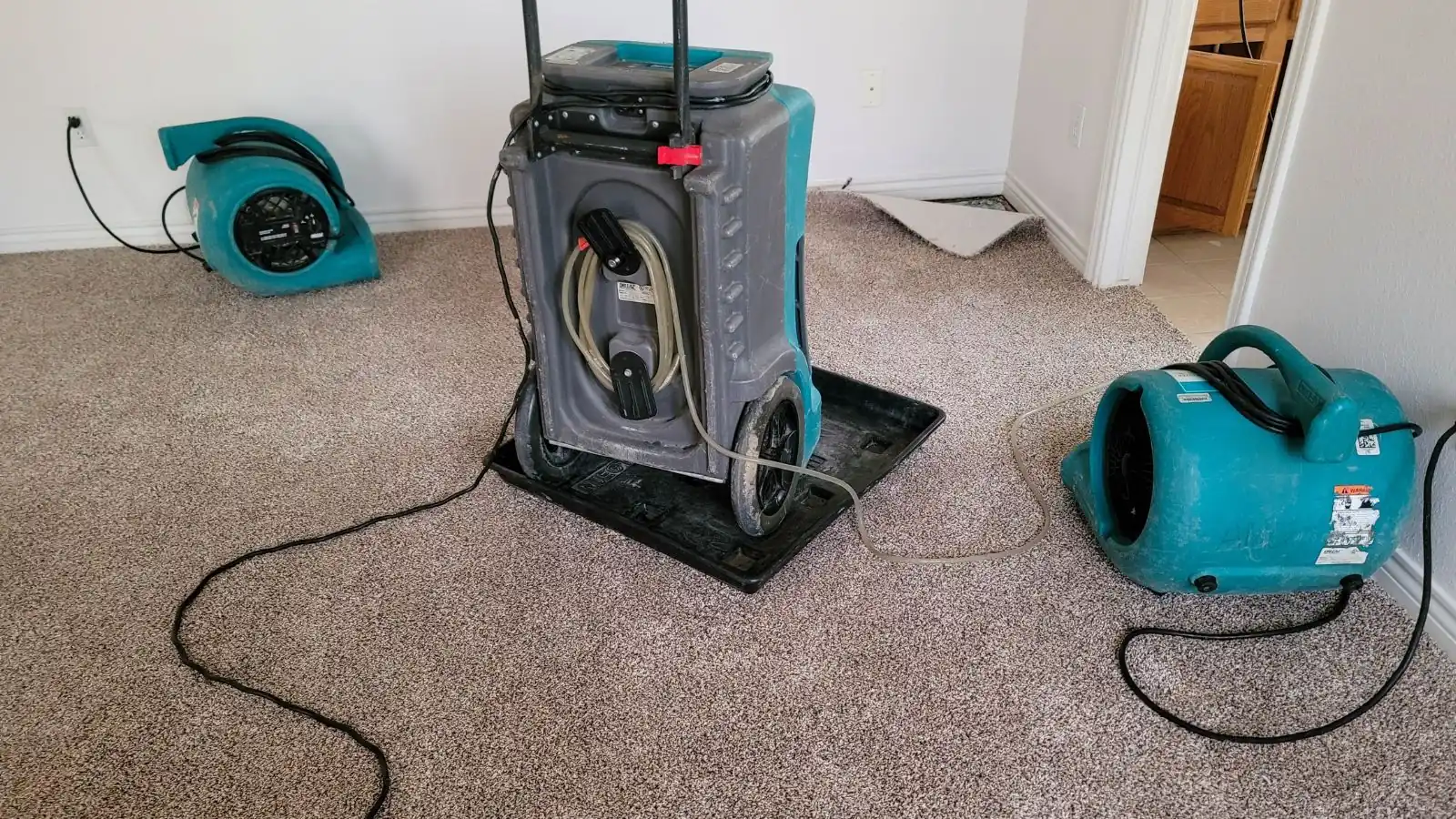
Air movers and dehumidifiers pull moisture out of materials. See structural drying.
Verify
Readings, not the smell alone, show it is dry.
Humidity and the numbers
The EPA advises keeping indoor humidity below 60 percent, and ideally between 30 and 50 percent. A cheap hygrometer shows where you are. If readings stay high after cleanup, something is still wet or the space needs dehumidification.
The EPA also says that if mold covers more than about 10 square feet, you should consider professional help. Smaller patches on hard surfaces can often be cleaned with detergent and water.
Smell without visible mold
A smell can come before anything is visible, because growth can be inside a wall or under a floor. Do not cut open walls to look unless you know how to contain the dust. A professional can use a moisture meter or a thermal camera to find the wet area without demolition.
If you want sampling, an independent assessor can test air or surfaces. Results need interpretation, and a lab report does not replace finding the moisture.
When to call for help
- The smell is strong or spreading.
- You had water in the building in the last few weeks.
- The smell returns after cleaning.
- You see staining, bubbling paint or warped materials.
- Anyone in the home is bothered by the air.
For larger growth, see mold remediation. For basements, see basement water damage cleanup. For wet carpet, see carpet water damage restoration.
Why basements here smell in summer
West Chicago summers are humid, and cool basement walls collect condensation. O'Hare records about 37.86 inches of precipitation in a normal year, so damp air is a regular visitor. A dehumidifier with a drain line, working gutters and sloped soil away from the foundation reduce the odor, but a smell that follows a flood needs drying.
Odors by type and what they suggest
| Odor | Possible source |
|---|---|
| Earthy and damp | Wet materials or high humidity. |
| Sour or sewer-like | Drain, trap or backup issue. |
| Sweet or chemical | Appliance, coolant or product, call a pro. |
| Rotten egg | Gas or drain issue, leave and call the utility if gas is possible. |
| Stale after carpet cleaning | Pad left wet. |
If you smell gas, leave the building and call 911 or the gas utility.
A smell that tracks with rain points to seepage. A smell that appears when the furnace runs points to ducts or a drain pan. Noting when it appears narrows the search.
If the smell came after sewage, treat the area as contaminated and read sewage backup cleanup.
Hidden places a smell can come from
Closets on exterior walls, the space behind a refrigerator, under a kitchen sink and inside a washer drum can all hold moisture. Check the places where air does not move and where a slow leak could sit unseen. A flashlight and a hand run along baseboards can find a damp spot.
Dryer vents that are not vented outside can put steam into a basement, and a clogged condensate drain on an air conditioner can leave a pan of standing water. See AC leak water damage for the second case.
Simple habits that help
- Run exhaust fans in baths and kitchens.
- Keep furniture a few inches from exterior walls.
- Clean gutters twice a year.
- Check under sinks monthly for dampness.
- Do not store cardboard on a basement floor.
- Replace filters on schedule.
If you have done these and the smell persists, a moisture assessment is the next step. It finds what your nose cannot.
Testing for hidden moisture
Pin-type and pinless moisture meters read the moisture content of building materials. A thermal camera shows temperature differences that often track with wet areas. Used together, they find damp places without cutting into walls.
Readings are compared to a dry reference from an unaffected area of the same material. That comparison matters more than a single number. See wall and drywall water damage repair for how a wet wall is checked.
How long a smell should last
After a proper dry-out, a damp smell should fade within days as materials reach normal readings. If it lingers for weeks, something is still wet or something porous was left in place. A second moisture check is cheaper than guessing.
Carpet, padding and insulation hold odor longer than hard surfaces. Replacing them is often the final step, and our carpet restoration page explains when a pad cannot be saved.
Where this guide uses restoration terms such as water categories and drying goals, they come from ANSI/IICRC S500, the published standard for professional water damage restoration.
What not to do
Do not seal the smell in with paint or air fresheners. Do not run a fan across wet material and call it dry.
Do not wait a month to see if it fades. If you are in Winfield or Bartlett, see our Winfield and Bartlett pages. Call (630) 580-6401 if the smell followed a leak or flood.
Common questionsQuestions about this topic in West Chicago
Not always, but it means moisture is present. Mold may be growing in a hidden place.
Remove wet materials, dry the structure and confirm with readings. Odor control follows drying, not the other way around.
It helps with humidity. It does not dry a wet wall cavity or remove growth.
Testing can help in some cases, but finding and drying the moisture is the first step.